Reaching the Hardest to Reach
Community-led efforts to include those living in extreme poverty
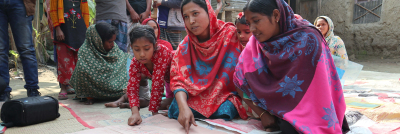
The programme is designed specifically to reach people living in extreme poverty - those whose needs are often overlooked by mainstream development efforts, including microfinance. Selection is not incidental - it is community-driven, transparent, and based on clear criteria to ensure that the most vulnerable households are prioritised.
How we identify participants
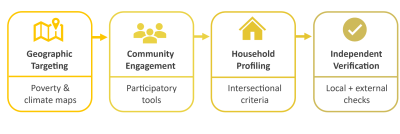
Our targeting process includes four stages:
1. Geographic targeting
Focus on regions with high poverty incidence and high exposure to climate hazards, based on poverty maps, climate vulnerability indices, and local knowledge.
2. Community engagement
Participatory Rural Appraisal tools - like Social Mapping, Wealth Ranking, and Focus Group Discussions - are used with community members to identify households in greatest need. These foundational methods ensure local ownership, transparency, and legitimacy, and are increasingly combined with digital tools and intersectional analysis to enhance accuracy and equity.3. Household profiling
Key Informant Interviews assess income, food consumption, land ownership, access to services, and participation in other programmes. Priority is given to:
- Female-headed households
- Indigenous and minority communities
- People with disabilities
- Elderly or dependent individuals
These criteria reflect intersecting forms of marginalisation that increase households’ exposure to risk and exclusion, and help ensure that support reaches those who face multiple, compounding barriers.
4. Independent verification
Pre-selected lists are cross-checked with local authorities, NGOs, and MFIs. Where possible, verification is supported by independent actors to ensure accountability.
This rigorous process results in a high degree of precision and legitimacy. It not only ensures that support reaches those most in need, it also lays the foundation for strong community relationships and long-term impact.