Evidence of Impact
Lasting change for families, communities, and systems

Our results are tracked with clear, verifiable indicators. After ~36 months of participation, cohorts typically achieve the following:
Household income and livelihood resilience
- Income growth: Over 80% of participating families increase per‑capita income by at least 120% (inflation‑adjusted, net of transfers).
- Diversified livelihoods: 90% of households earn income from three or more distinct livelihood activities with different profit cycles (e.g., short‑cycle poultry/vegetables, medium‑cycle goats, longer‑cycle cattle/leased land).
Food security and diet quality
- Adequate meals: 95% of participants can secure three nutritious meals
- Dietary diversity: Using an adapted Household Dietary Diversity Score (HDDS), around 95% of participating households access ≥10 food groups.
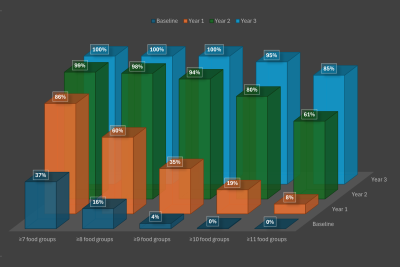
HDDS tracks how many distinct food groups a household consumed in the last 24 hours; higher values indicate better dietary diversity and food access. In our cohorts, the share of households reaching ≥8 food groups rose from 16% at baseline to 100% by Year 3, and ≥10 from 0% to 95%.
Risk mitigation and preparedness
- Climate/DRR action plans: 90% of participating households maintain a household action plan that documents climate risk management and disaster preparedness measures (e.g., early warning access, shelter/evacuation, flood/drought practices in farming).
Rights, services, and accountability
- Service claims by SHGs: 90% of community‑based SHGs (village and municipal levels) proactively claim safety nets and other state services; 80% of these claims are approved by authorities.
- Right to information: Members of the direct target group file Right to Information (RTI) requests and track their follow‑up with relevant agencies.
- Collective protection: 95% of SHGs led by or representing marginalised groups implement specific protection measures (e.g., support in resolving local resource conflicts)
System change and policy influence
- Local decision‑making: Local decision‑making bodies (e.g., village councils, municipal councils) discuss programme policy briefs and analyses and are informed by target group perspectives.
- National policy dialogue: Concrete recommendations on national policies regarding the rights of marginalised groups in the climate context are developed by civil society actors and discussed with national decision‑makers in meetings and seminars; national media disseminate these policy asks.
Cumulative programme reach (since 2002)
- Approximately 300,000 people have met our programme’s graduation criteria for exiting extreme poverty, with gains sustained through the end of support, while self‑help groups and federations continue beyond project cycles.
Validated by independent research
External evaluations commissioned by international donors (e.g., EU, BMZ), alongside academic collaborations, confirm relevance, efficiency, and impact, particularly on climate adaptation and gender empowerment. Evidence is generated through baseline/endline surveys, outcome mapping, case tracking, and administrative records, with periodic independent verification.


